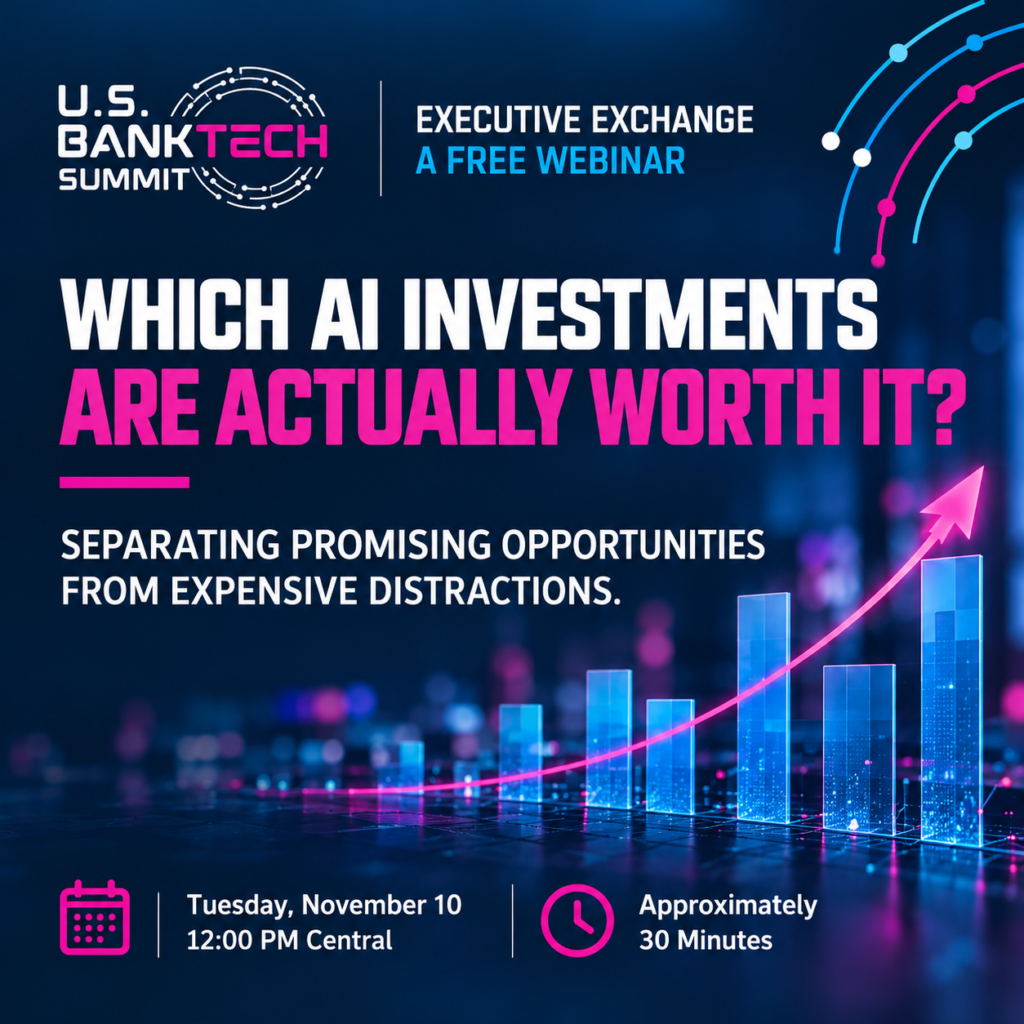
On November 10, 2026, Converge Events hosted an Executive Exchange on what’s real, what’s hype, and what’s actually delivering results in AI in banking. Sarah Grooms, chief of staff to the head of banking at Wintrust Financial, sat down with Akash Nikam, who leads products and engineering in Vanguard’s AI Center of Excellence. There were no slides, just a working conversation in the same format as the U.S. BankTech Summit.
Don’t spend the next AI dollar on another chatbot
Sarah’s test was straightforward: “Let’s say you got handed a million dollars for AI tomorrow, just an additional million dollars. Where would you invest it, and where would you absolutely not spend it?”
Akash said: “I would invest a million dollars in setting up this evaluation harness for evaluation and oversight, because building an agent is easy, but to make sure it’s good enough to be shipped to our clients is the hard part.” That is “where most of the use cases stall in large firms and regulated firms especially.” He would invest in people who can evaluate non-deterministic systems, together with the experts and stakeholders who “define what good is.” He “would definitely not spend it on building another chatbot.” This “unglamorous but very important work,” he said, is “how you enable agents to scale.”
Meet stakeholders where they are
Sarah had seen business lines clamoring for a capability, then discovering how much testing stands between a request and a rollout. A lot of people, she said, still think you can “just flip a switch and it’s on, and now we’re doing AI.”
Akash did not claim a finished playbook. “I can’t sit here and tell you we’ve solved any framework.” The core “is from meeting the stakeholders where they are at. So if someone doesn’t sit too close to the technology, then it’s your job as a technologist to go to where they can understand what you’re talking about.”
Testing in hours, once governance and intake are in place
Akash did not name specific use cases. What he could share: his teams have used AI for large-scale evaluations and are “enabling teams to do large-scale behavioral, functional, adversarial testing in a few hours as opposed to taking days and days,” so other teams can “build their agents and be confident in when they go to production.”
Sarah, speaking from a Wintrust perspective: “We’ve been spending a lot of time on getting the governance right and the intake process.” Platforms that had “automatically AI-enabled things” were shut off “because we wanted to make sure that our data was being safeguarded and that we had the right guardrails in place.” Then came “figuring out where the best bang for the buck is to turn those sorts of things on.” She wouldn’t name departments: “anywhere in the bank where large volumes of reading have to be done… Those are ways that people are saving oodles of time.”
When AI adds work instead of saving it
Sarah asked: if you are “always being asked to be doing more with less, how are you going to make sure that this just isn’t another way for me to do more with less? Now, I’m just doing more with more.”
A weak answer from an agent, she added, can take longer to check than doing the work yourself. That “sours people on AI really quickly” if teams don’t have a “nuanced view” of what the tool is right for “in this moment in time.”
Akash had been “nodding the whole time.” He called it “doing more with more” and “the context rot that your brain is now going through”: “You can get more done in four hours. So now you have four more hours to do four more things.” Then “you’re all on the surface of all of those things. Now you’re doing eight things, but you don’t know how deep these things have gone.”
Sarah’s own example, from Copilot: “This thing is working on like 17 different tasks for me, and I don’t have time to read any of the outputs. So it’s like I’ve just dug a bigger hole for myself.”
Can you tell a customer’s AI agent from the customer?
Akash also described customers’ own AI agents “that will call the banks, move money, dispute charges, open accounts, and our controls are built for humans.” The question he wants worked through now: “How do we even authenticate if that agent, first of all, [is a] human or an agent; second of all, if that agent is actually associated with one of our clients?”
What this means for your institution
If this exchange is a guide, the next useful dollar in AI in banking belongs in evaluation, oversight, and the people who can say what “good” looks like at your institution. Governance and intake belong before tools get turned on, education has to meet the business where it is, and adoption stalls when the work AI creates outweighs the work it removes. The agent-to-agent question is early, but already visible.
None of that gets solved in a keynote. It gets solved in a room.
Continue the conversation at the U.S. BankTech Summit
The Executive Exchange was a short version of the U.S. BankTech Summit: conversation-first, no slide presentations, from Converge Events. Sarah, who will be in Chicago-Oak Brook, put it simply: “No slides, just talk. The networking is everything at your events, and so I’m really excited to be there.”
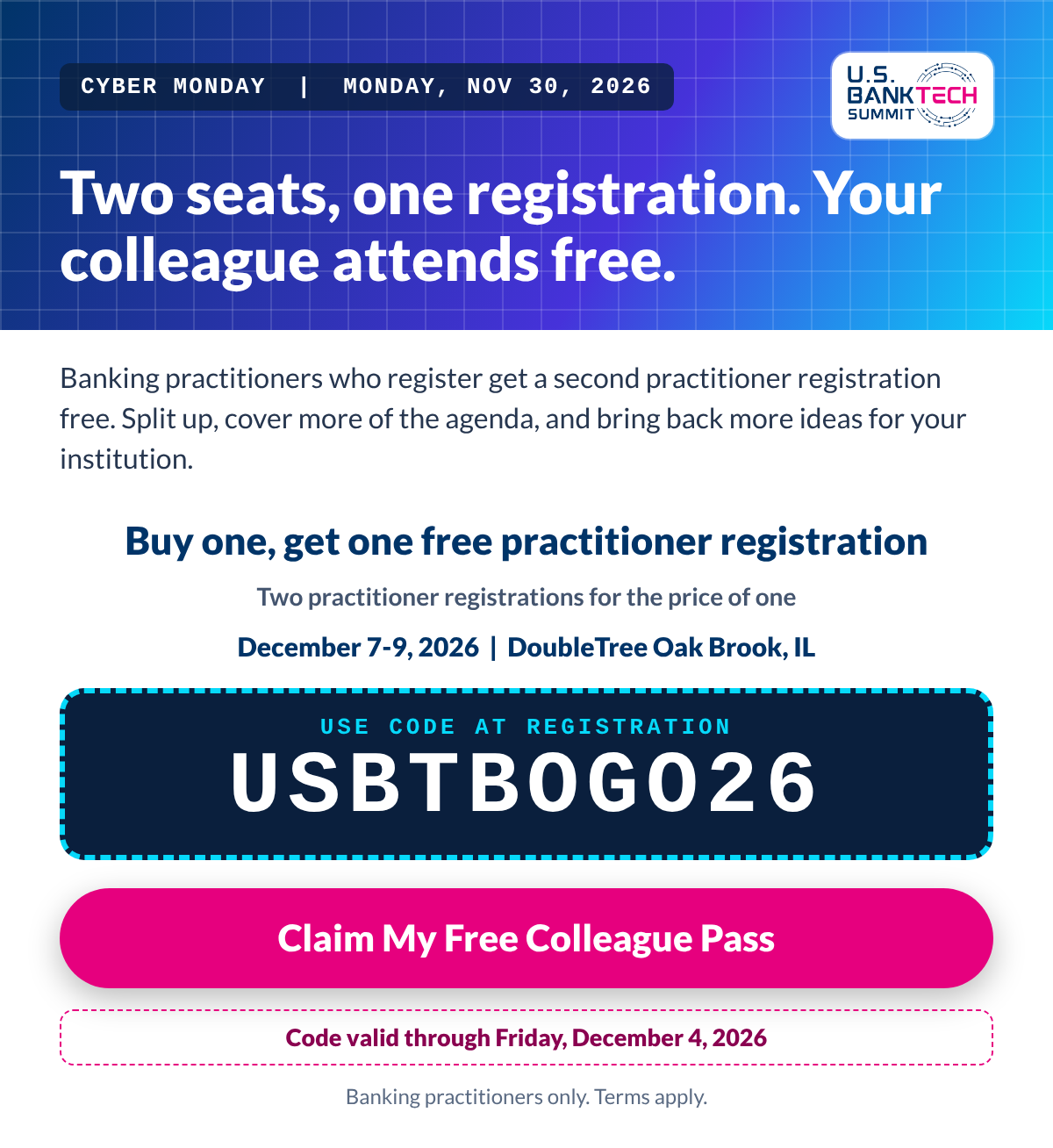
The U.S. BankTech Summit is December 7 to 9, 2026, at the DoubleTree by Hilton Chicago-Oak Brook. If you are coming with colleagues, Financial Institution Team Registration is available for three or more FI professionals from the same organization and includes one complimentary VIP upgrade per team.